Rise and Triumph of the California Right, 1945-66 by Kurt Schuparra
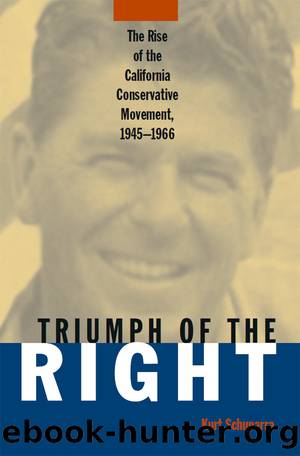
Author:Kurt Schuparra [Schuparra, Kurt]
Language: eng
Format: epub
Tags: International Relations, Political Science, General
ISBN: 9781315292755
Google: XJ4YDQAAQBAJ
Goodreads: 32206325
Publisher: Routledge
Published: 2016-09-16T00:00:00+00:00
Seven
Triumph of the Right
The issues that proved to be obstacles to Pat Brown in his reelection drive did not reflect well on the state of liberalism in California or the rest of the nation. Though the backbreaking squeeze would not come until 1968, liberalism was caught in an ever-tightening vise by the summer of 1966, with the âNew Leftâ on one side and a growing number of conservativesâespecially on social mattersâon the other. The âcountercultureâ would not fully emerge until the following year (with the âsummer of loveâ), but the antiestablishment politics of young student activists and like-minded others coalesced around opposition to the escalating war in Vietnam. Generally supportive of that battle against communism and ardently against protesting students, conservatives vented their anger over President Johnsonâs War on Poverty through polemics that could be summed up in good part by the buttons and bumper stickers that proclaimed: âJoin the Great SocietyâGo on Welfare!â His legislative accomplishments as president notwithstanding, Johnsonâs vision of a Great Society had withered in two short years due to a lack of nurture in a nation that was coming apart rather than together. Ironically, the resentful and divisive âus against themâ rhetoric that had helped spur New Deal liberalism under Rooseveltâhis âforgotten manâ versus the callous âeconomic royalistsââwould now be used by conservatives against ânonproducersâ to undermine the kindred liberalism of the Great Society.
Leading this assault in California, Reagan pledged to âlisten to the people, not lecture them.â He attacked the policies of both Johnson and Brown, but made sure he âwas offering positive alternatives,â as outlined in the Creative Society.1 Still, his disarming amiability proved to be his greatest asset, as it usually concealed, at least partially, the grating negativity of conservative resentments over civil rights and the growth of government bureaucracies. Assiduously rehearsed yet seemingly natural, Reaganâs ability to at once charm and chastise enhanced his gravitational pull on Republican moderates who had supported Christopher. One week after the latterâs defeat, his leading financial backers pledged their support to Reagan at a public meeting for party unity attended by the hierarchy of the Friends of Ronald Reagan. Christopher backer Thomas Pike, who had served in the Eisenhower administration, stated that the actorâs philosophy âcomes very closeâ to that of the former president.2 Clearly an overstatement, Pikeâs assertion nonetheless portended that if Reagan lost to Brown, it would not be due to Republican factionalism. Deciding to beat up on Democrats instead of themselves, the Republican right in Californiaâwhich now accounted for almost half the stateâs party membershipâand the Modern Republicans at long last declared a truce. As Henry Salvatori happily proclaimed, â[t]he GOP has finally come through in one piece.â3
The quest for party solidarity, however, was not entirely successful because Thomas Kuchel made clear he would not endorse Reagan. Openly backing Christopher in the primary election, Kuchel nonetheless agreed during that campaign to be a cochairman of a Republican âunityâ dinner in Los Angeles on June 23, but declined to actually attend due to âofficial duties.
Download
This site does not store any files on its server. We only index and link to content provided by other sites. Please contact the content providers to delete copyright contents if any and email us, we'll remove relevant links or contents immediately.
The Secret History by Donna Tartt(19086)
The Social Justice Warrior Handbook by Lisa De Pasquale(12190)
Thirteen Reasons Why by Jay Asher(8909)
This Is How You Lose Her by Junot Diaz(6886)
Weapons of Math Destruction by Cathy O'Neil(6279)
Zero to One by Peter Thiel(5801)
Beartown by Fredrik Backman(5754)
The Myth of the Strong Leader by Archie Brown(5507)
The Fire Next Time by James Baldwin(5444)
How Democracies Die by Steven Levitsky & Daniel Ziblatt(5218)
Promise Me, Dad by Joe Biden(5153)
Stone's Rules by Roger Stone(5087)
A Higher Loyalty: Truth, Lies, and Leadership by James Comey(4962)
100 Deadly Skills by Clint Emerson(4925)
Rise and Kill First by Ronen Bergman(4788)
Secrecy World by Jake Bernstein(4753)
The David Icke Guide to the Global Conspiracy (and how to end it) by David Icke(4717)
The Farm by Tom Rob Smith(4507)
The Doomsday Machine by Daniel Ellsberg(4490)
